Shock Wave or Laser Therapy: What Does the Evidence Say?
Extracorporeal Shock Wave Therapy (ESWT) and laser therapy — Low-Level Laser Therapy (LLLT) and High-Intensity Laser Therapy (HILT) — are widely used in the rehabilitation of patients with musculoskeletal disorders.
These methods are used as non-invasive approaches to reduce pain, improve function, and promote the recovery of damaged tissues. However, widespread clinical use does not necessarily mean that technology has a proven advantage over another.
Two systematic reviews and meta-analyses published in Lasers in Medical Science in 2024 and 2025 allow the comparative effectiveness of these approaches to be assessed. Their findings do not provide convincing grounds for considering any of the methods universally more effective. At the same time, the quality and heterogeneity of the available studies do not yet allow a definitive conclusion.
More relevant information is available via LINK
Why Is Comparing These Methods Clinically Relevant?
Musculoskeletal disorders (MSKDs) are among the leading causes of chronic pain, limitations in physical activity, and reduced quality of life.
This group includes numerous conditions, such as chronic low back pain, osteoarthritis, tendinopathies, plantar fasciitis, lateral epicondylitis, carpal tunnel syndrome, and other disorders affecting joints, muscles, tendons, and periarticular tissues.
According to one of the reviewed analyses, approximately 1.71 billion people worldwide were living with various musculoskeletal disorders in 2019. The scale of the problem explains the continuing search for effective non-invasive treatment and rehabilitation methods.
How Do Shock Wave and Laser Therapy Differ?
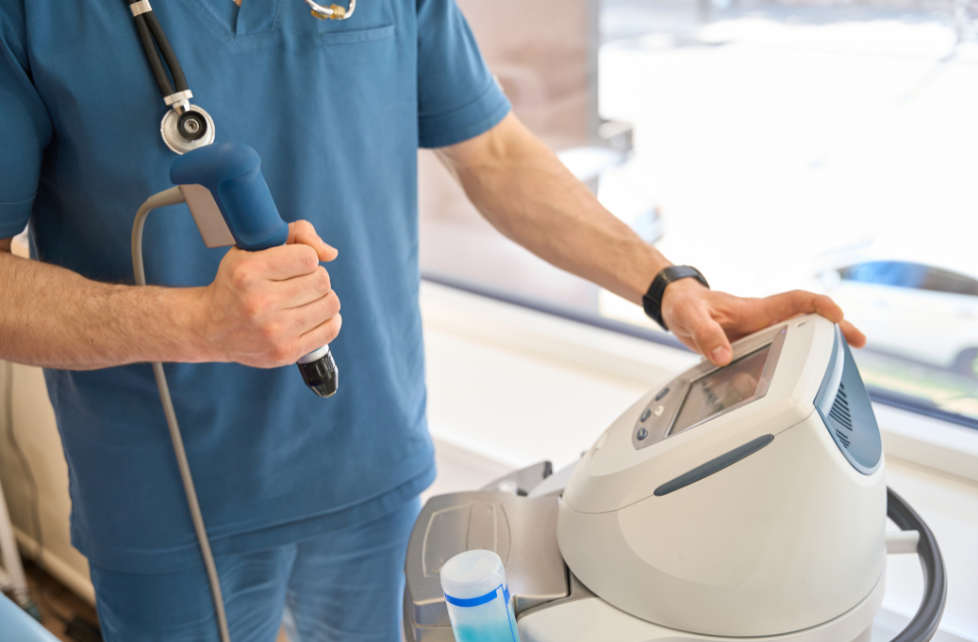
Extracorporeal shock wave therapy is based on the application of acoustic waves to pathologically altered tissues. Mechanical stimulation is thought to activate repair processes and may influence local circulation, metabolic processes, and mechanisms of pain.
At the same time, shock wave therapy is not a fully standardized procedure. Studies have used radial and focused waves, with substantial differences in intensity, frequency, energy parameters, and number of sessions. In some studies, the type of wave used was not clearly specified at all.
Low-level laser therapy is a form of photobiomodulation. Light energy affects cellular processes and is thought to contribute to reductions in inflammation and pain, improved microcirculation, and tissue repair. Its effects on fibroblast activity and collagen synthesis are also discussed.
High-intensity laser therapy uses higher power and combines photobiological and thermal effects. It is thought to allow treatment of deeper tissues and may influence pain, inflammation, and repair processes in musculotendinous structures.
Thus, the mechanisms of action of these technologies differ, while their clinical goals are largely the same — pain reduction and restoration of function.
Low-Level or High-Intensity Laser Therapy: Is Either Superior?
The systematic review by Saleh et al., published in 2024, included 12 randomized controlled trials involving 704 patients.
The studies investigated different conditions: lateral epicondylitis, carpal tunnel syndrome, chronic nonspecific low back pain, knee disorders, plantar fasciitis, and subacromial impingement syndrome.
Overall, no substantial differences between the two types of laser therapy were identified for the main clinical outcomes.
Both methods showed comparable effects on pain, functional limitations, quality of life, electrophysiological measures, and some parameters of physical function.
Individual studies suggested possible advantages of low-level laser therapy for grip strength. At the same time, high-intensity therapy showed better results for some ultrasound parameters of specific musculotendinous structures.
However, these findings cannot be regarded as evidence of an overall superiority of either technology.
The authors emphasize an important limitation: because of differences between studies, a complete quantitative analysis was possible only for a small proportion of the included studies. Differences concerned both patient characteristics and the outcomes assessed. Therefore, the evidence is insufficient to recommend one type of laser therapy as the preferred approach.
Can Shock Wave Therapy Outperform Laser Therapy?
This question was central to the systematic review by Hassan et al., published in 2025.
The review included 28 randomized controlled trials and 1460 patients. In 18 studies, shock wave therapy was compared with low-level laser therapy, while 10 compared it with high-intensity laser therapy.
The main outcomes evaluated were pain, functional status, muscle strength, range of motion, and quality of life.
The principal finding was relatively consistent: for most major outcomes, no substantial differences were identified between shock wave and laser therapy.
A small advantage of shock wave therapy was observed for short-term functional status compared with low-level laser therapy. However, the result was at the threshold of statistical significance and was accompanied by considerable study heterogeneity. It therefore cannot be considered convincing evidence of superiority of shock wave therapy.
When compared with high-intensity laser therapy, no advantage of shock wave therapy was identified for functional outcomes.
Does ESWT Really Reduce Pain More Effectively?
Current research does not provide a definitive answer to this question.
In short-term assessments, shock wave therapy did not demonstrate a convincing advantage over low-level laser therapy in reducing pain. A similar pattern was observed when it was compared with high-intensity laser therapy.
At the same time, the results depended on the specific condition.
For example, in lateral epicondylitis, some studies indicated an advantage of high-intensity laser therapy for pain reduction. In plantar fasciitis, no convincing differences between the methods were identified.
This highlights an important principle: results obtained for one condition cannot automatically be generalized to the entire group of musculoskeletal disorders.
How Do the Methods Affect Function and Physical Capacity?
According to the meta-analysis, no pronounced and sustained advantage of one technology was identified for the recovery of muscle strength.
Interestingly, direct comparison of the two types of laser therapy showed an advantage of low-level laser therapy for grip strength. However, the broader analysis that included comparison with shock wave therapy did not confirm a consistent advantage of any method for this outcome.
Data on range of motion are also limited. Only a small proportion of studies assessed this outcome, making it impossible to reliably determine whether any technology has an advantage in range of motion.
A similar situation is observed for quality of life. Some studies identified differences between methods, but these concerned individual components of specific scales and did not demonstrate a sustained advantage of one technology for overall quality of life.
Why Are the Study Results So Difficult to Compare?
The main problem with the current evidence base is study heterogeneity.
First, the studies included patients with different conditions, different symptom durations, and different degrees of disease severity.
Second, the treatment protocols themselves varied considerably. Different types of waves and different exposure parameters were used for shock wave therapy. For laser therapy, wavelength, power, energy parameters, procedure duration, and number of sessions differed. In some studies, these treatment parameters were described in insufficient detail.
Third, physical modalities were often used as part of combined treatment — for example, together with therapeutic exercise, other physiotherapeutic procedures, or conventional treatment. It is therefore not always possible to determine which specific component produced the observed improvement.
Finally, many studies included a small number of participants and had a relatively short follow-up period.
Additional facts on related topics are available via LINK

How Reliable Are the Available Results?
The quality of evidence is one of the most important limitations.
In studies of physical treatment modalities, it is difficult to completely exclude the influence of patient and clinician expectations. Therefore, appropriate blinding of participants, clinicians, and outcome assessors is particularly important when technically feasible.
Such procedures were applied inconsistently in the reviewed studies. In several studies, participants or clinicians knew which treatment was being used, potentially influencing subjective assessments of pain and functional status.
Another problem was heterogeneity of results between studies. Differences persisted even after analyses of individual subgroups. This makes it difficult to determine which patients derive the greatest benefit from a particular technology.
Assessment of evidence quality using the GRADE system (Grading of Recommendations, Assessment, Development and Evaluations) also demonstrated limitations. For most key outcomes, the certainty of evidence ranged from low to very low. Consequently, new high-quality studies could substantially change the current conclusions.
What Is Known About Safety?
Both methods are non-invasive, but this does not mean that adverse events are completely absent.
Studies of shock wave therapy reported local pain, redness, and bruising. However, information on adverse events was not provided in all studies, limiting a comprehensive assessment of safety.
Safety assessment for laser therapy is also insufficiently standardized. Differences in treatment parameters make direct comparison of adverse events between studies difficult.
Can the “Best” Method Be Identified Today?
Based on the two systematic reviews, it cannot be stated that ESWT, LLLT, or HILT is a universally superior technology for treating musculoskeletal disorders.
At the same time, it is important not to draw the opposite conclusion and state that these methods are ineffective.
Individual studies demonstrate positive effects of each technology on pain, function, and other clinical outcomes. The problem is that the results are not sufficiently homogeneous or reliable to establish a consistent advantage of one method.
It is essential to distinguish between two statements:
“No statistically significant differences between the methods were identified” and “the methods have been proven to be equally effective.”
The first statement is supported by the results of several studies. The second has not yet been established.
What Is Needed to Develop More Reliable Recommendations?
Large randomized studies with clear diagnostic criteria, standardized treatment protocols, and long-term follow-up are required.
Specific disorders should be studied separately rather than combining fundamentally different pathological conditions within a single analysis. Treatment parameters should also be standardized, protocols described in detail, and consistent clinically meaningful outcomes used.
Particular attention should be paid not only to statistical significance but also to clinical significance — that is, whether the observed improvement is genuinely meaningful for the patient and their everyday function.
What Does Evidence-Based Medicine Say Today?
Current evidence does not confirm a clear superiority of extracorporeal shock wave therapy, low-level laser therapy, or high-intensity laser therapy for musculoskeletal disorders.
Shock wave therapy demonstrated a small advantage over low-level laser therapy for one short-term measure of function, but the quality of this evidence remains insufficient. When compared with high-intensity laser therapy, no convincing advantage of shock wave therapy was identified.
Similarly, direct comparison of the two types of laser therapy did not demonstrate a sustained superiority of either low-level or high-intensity laser therapy.
Available data indicate a relative clinical benefit of all three methods, but the evidence base remains insufficient to confidently prefer one technology over another.
This does not mean that ESWT, LLLT, or HILT has been proven ineffective. However, individual positive findings are also insufficient to consider any of these technologies proven superior to the others.
For practicing clinicians, selection of a method should take into account the specific disorder, clinical situation, patient characteristics, and treatment availability. Definitive determination of the optimal approach requires larger, standardized, methodologically rigorous studies.
References
- Hassan MI, Saleh MSM, Sallam MH, Elkhodary HH, Sayed MM, Samy H, Mohamed AH, Ashour AS, Mosaid EM, Zaghloul MH, Elbathesh RE, Vaish H, Abdullah A, Mohammed A, Abdelhamed AI.Extracorporeal Shock Wave Therapy versus laser therapy in treating musculoskeletal disorders: a systematic review and meta-analysis. Lasers in Medical Science. 2025;40:194. DOI: 10.1007/s10103-025-04392-0.
- Saleh MS, Shahien M, Mortada H, Elaraby A, Hammad YS, Hamed M, Elshennawy S. High-intensity versus low-level laser in musculoskeletal disorders. Lasers in Medical Science. 2024;39:179. DOI: 10.1007/s10103-024-04111-1.