Hormonal regulation and circadian sleep rhythms with age-related changes
The authors of the article “Sleep in normal aging” (Junxin Li et al, “Sleep medicine clinic”, 2018) described the physiology and circadian rhythms of sleep during age-related changes from the perspective of hormonal regulation.
The circadian system is an evolutionarily established biophysical and biochemical regulator of the human immune system, associated with the cyclic alternation of day and night and normally forming a 24-hour cycle. This ancient mechanism regulates a number of important human physiological functions:
- Body temperature
- Heart rate
- Blood pressure
- Bone remodeling
- Sleep-wake rhythm
- Rest-activity pattern
The anatomical structure responsible for circadian rhythms is located in the anterior hypothalamus and is called the suprachiasmatic nucleus (SCN - nucleus suprachiasmaticus). Regulation of circadian rhythms is achieved through signals received by the SCN from the retina. The SCN is the central endogenous circadian driver of the 24-hour rhythm. The main functions of the SCN are:
- Generation of circadian rhythms
- Control of melatonin secretion by the pineal gland
- Synchronization of all “biological clocks” in the body
- Reduced adaptation to phase shifts (decreased ability adjusting to phase-shifting)
More relevant information is available via LINK
Circadian rhythms become less stable with age, which is manifested by reduced circadian amplitude and decreased adaptation to phase shifts. For example, in older people the sleep schedule is usually shifted to earlier hours: sleepiness occurs earlier in the evening, and awakening occurs earlier in the morning. Such a phase shift is observed not only in the “sleep-wake” cycle, but also in the cycles of body temperature fluctuations, melatonin secretion, and cortisol secretion, and in older people these occur approximately 1 hour earlier than the corresponding cycles in younger people. Older people find it more difficult to adapt to phase shifts, for example, shift work and changes in time zones. Accordingly, older people require more time to recover after a phase shift.
Reduced amplitude of circadian rhythms (reduced amplitude in circadian rhythms)
The age-related decrease in circadian amplitude is associated with sleep disturbances. It has been established that, compared with younger people, older people wake more often at the time when body temperature reaches its minimum. In addition, reduced amplitude of daytime activity also promotes daytime sleep in older people. The age-related reduction in the amplitude of melatonin secretion also causes sleep problems. Thus, one study showed that older people wake 2.7 times more often than younger people, supporting desynchronization and reduced amplitude of circadian rhythms (Klerman EB et al, 2004).
Hormonal regulation of sleep (sleep-related hormones)
Hormones involved in sleep regulation:
- Growth hormone (growth hormone)
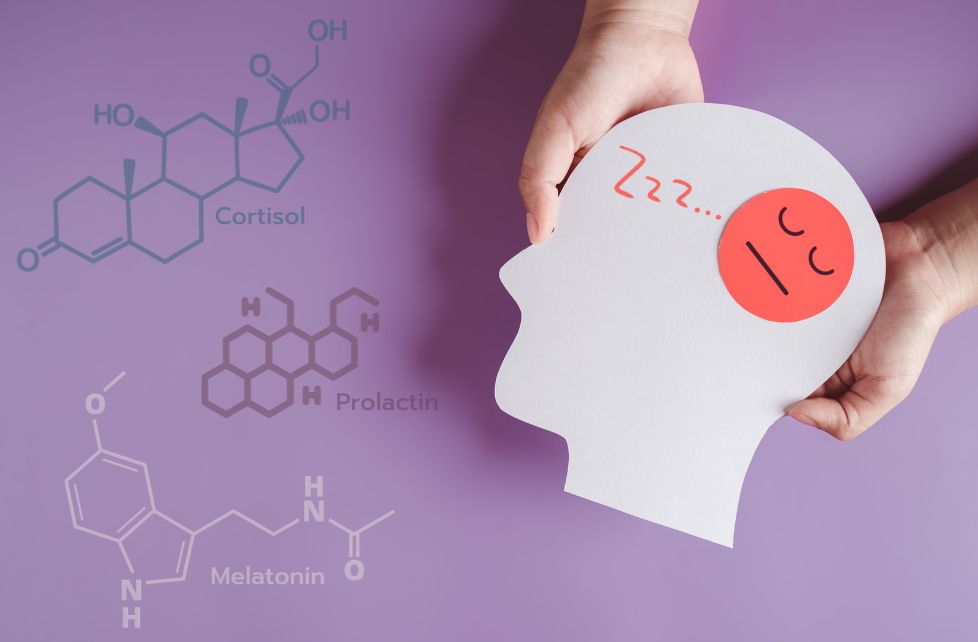
- Cortisol (cortisol)
- Prolactin (prolactin)
- Thyroid-stimulating hormone (TSH - thyroid-stimulating hormone)
- Melatonin (melatonin)
- Sex hormones (sex hormones)
Growth hormone
Growth hormone secretion reaches its peak during adolescence, decreases exponentially during the transition from young to middle age, and then slowly declines toward older age. Growth hormone secretion begins approximately one hour after falling asleep and decreases with brief awakenings. Suppression of growth hormone secretion leads to stimulation of corticotropin secretion. The age-related decrease in nighttime growth hormone levels also directly and indirectly affects the slow-wave sleep phase (SWS – slow wave sleep), reducing the duration of this phase.
Cortisol
Cortisol secretion has a clearly defined circadian pattern: it reaches its peak after morning awakening, gradually decreases during the day, and reaches its minimum by evening. Sleep suppresses cortisol secretion. An increase in cortisol levels during sleep leads to awakenings. The circadian rhythm of cortisol release changes with age. This is manifested by reduced amplitude and increased nighttime cortisol levels, which consequently causes reduced SWS and frequent awakenings.
Prolactin
There is insufficient evidence that prolactin influences sleep. However, it is reliably known that sleep affects prolactin secretion. Regardless of daytime or nighttime sleep, increased prolactin secretion is observed in the initial phase of sleep. With age, prolactin secretion decreases because sleep becomes more superficial and fragmented. Nighttime prolactin levels are significantly lower in older people (Klerman EB et al, 1990).
Thyroid-stimulating hormone
TSH secretion also follows a circadian pattern: a consistently low level is maintained during the daytime, an increase begins closer to evening and reaches its peak around the time of falling asleep, and then gradually decreases during the night. Circadian TSH secretion is preserved with age, although the total TSH level is reduced.
Melatonin
Melatonin levels depend on the dark and light periods of the day. Analysis of the 24-hour profile of melatonin secretion demonstrated a consistently low daytime level, a progressive evening increase beginning two hours before sleep, a consistently elevated level during the middle period of sleep, and a gradual decline to daytime levels during the morning hours. The onset of evening sleepiness correlates with an increase in evening melatonin secretion. In older people, reduced melatonin secretion leads to sleep disturbances.
Sex hormones
In men, testosterone levels gradually decrease after the age of 30. The reduction in testosterone in older people is additionally associated with sleep fragmentation and superficial sleep.
In women, estradiol levels decrease and follicle-stimulating hormone (FSH) levels increase with age. These processes are particularly pronounced during the perimenopausal period. In turn, changes in female sex hormone secretion cause complaints of difficulty initiating and maintaining sleep. In addition, reduced levels of endogenous estrogen and progesterone have a suppressive effect on the upper airways, increasing the frequency of respiratory movements during sleep.
Additional facts on related topics are available via LINK
Risk factors for sleep disturbances in older people
Most sleep parameters decline with age but remain unchanged after the age of 60. The sleep changes described concern healthy older people and are often perceived by them as normal age-related changes. However, in ordinary daily life, aging is associated with concomitant somatic and mental disorders, reduced social activity, and lifestyle changes. All of these factors contribute to changes in sleep. Thus, up to 60% of older people report a significant reduction in sleep quality. Therefore, sleep problems are not always related solely to age.
Concomitant somatic and mental disorders
The most common concomitant somatic diseases in older people are:
- Osteoarthritis
- Cardiovascular disease
- Lung diseases
- Gastroesophageal reflux
- Cancer
- Diabetes
Up to 67% of older people report one or another concomitant condition. Approximately 90% of people older than 65 years receive pharmacological treatment, and more than one third of them take more than 5 medications. Discomfort, adverse effects of medications, and emotional distress negatively affect sleep quality by increasing the number of awakenings. Common complaints among these patients include:
- Insomnia
- Sleep apnea
- Restless legs syndrome – a condition characterized by unpleasant sensations in the feet and lower legs while falling asleep, forcing the person to make constant movements to relieve the discomfort
Depression, anxiety, and other psychiatric problems often manifest as insomnia. In turn, insomnia increases the risk of depression.
Influence of social factors on sleep
Although older people have a more flexible sleep schedule and can take a daytime nap to compensate for insufficient nighttime rest, reduced social activity and a sedentary lifestyle still contribute to sleep disturbances. Loss of loved ones, loneliness, loss of independence, and relocation to facilities providing additional care are significant stressors for aging people.
Conclusion
Age-related changes affect sleep:
- total sleep duration increases
- nighttime sleep duration decreases
- daytime sleep duration increases
- the number of nighttime awakenings increases
- the duration of slow-wave sleep (SWS) decreases
Sleep remains virtually unchanged after the age of 60 in healthy people. Age-related changes in neuroendocrine functions correlate with changes in sleep architecture during normal aging. Sleep disturbances in older people are promoted by somatic and mental comorbidities, reduced social activity, and changes in the environment.
Read about the parameters of normal sleep during age-related changes in our article “Normal sleep during age-related changes”.
References
Li J, Vitiello MV, Gooneratne NS. Sleep in Normal Aging. Sleep Med Clin. 2018;13(1):1-11. doi:10.1016/j.jsmc.2017.09.001